Lithium-ion Battery: An Overview
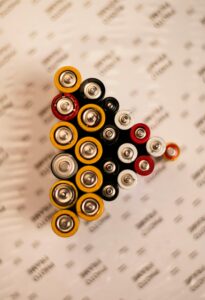
Lithium-ion batteries are ubiquitous in today’s world. They are found in almost all of the consumer electronic devices being sold at present. The Li-ion battery was invented in 1974. However, its widespread adoption only came around 1991, because of safety concerns. Lithium is a highly reactive metal, and multiple innovations had to be made in terms of the battery structure and packaging to make it commercially viable.
Trivia: The term Lithium comes from the Greek word “lithos” which means “stone”. Lithium was discovered in 1800 by a Brazilian chemist in a mine. He named it after the word for “stone”, because the element was discovered as a solid mineral.
To understand how Lithium-ion batteries degrade, you must first understand how they work.
Structure of the Lithium-ion Battery:
As with any battery power source, the Li-ion battery has two electrodes: Lithium-based material as Cathode and Graphite as Anode. It is called Li-ion battery because, when these materials are put together as anode and cathode, the current flow is facilitated by the formation of Lithium ions, which are positive in nature.

Figure 1. Working of a Li-ion Battery. Image Courtesy: Battery University
Let me explain. Graphite is a highly unreactive element. But graphite has a physical structure (which you can only see through an electron microscope) that can kind of “hold” the Lithium ions in its free spaces; Kind of like a bookshelf holding books. This property is called “Intercalation” and was a game-changer in making the Li-ion battery commercially viable.
Now since graphite is unreactive, to facilitate the movement of ions from the cathode to the anode, you will need an electrolyte. If you had seen car batteries, you might recognize the liquid in those (typically) lead acid batteries; that is the electrolyte for that particular type of battery. However, using a liquid electrolyte is kind of inconvenient in most modern applications where Li-ion batteries are used, and it also adds to the weight. So, the electrolyte is generally of gel or dry polymer type, to which additives are added to increase the conductivity of the positive lithium ions. The electrolyte filled in the holes of a porous, insulating material called the “separator” (generally, polyolefin). The separator is there to melt and seal the pathways between the cathode and anode, in case of large number of ion-release, to prevent fires. When placed together, the cathode and the electrolyte undergo chemical reactions to produce lithium ions. When an external connection is made to both the electrodes, generally in the form the thing to be charged, the electrons on the anode side get attracted to the cathode side, and flow through the external circuit since it has lesser resistance compared to the internal separator. The lithium ions in the electrolyte, on the other hand, settle on the rack-like structure of the graphite anode. And when they are charged, the ions return to the electrolyte, to their stable form.
Causes of Degradation:
Following the second law of thermodynamics, any natural thing tends to move towards disorder or decay, when operating in the real world. The causes of degradation of a Lithium-ion battery are often the charge discharge current values, operating temperature, and the extent to which it is discharged before it is charged again.
The ideal range of operation is generally to charge and discharge the battery at one-third of its rated current. This is because at higher currents, the lithium ions get produced in large number and they do not get the time to return back to the electrolyte, thus settling in a metal form, on the surface of the graphite itself. This is called “Lithium plating”. Once it settles, you will not be able to get it back for regular operation, in the commercial usage. This results in the reduced amount of Lithium available for use as a power source, and hence the amount of energy you can derive from the battery reduces. This loss of lithium is called “Loss of Active Material”.
Temperature also plays a vital role in degradation, as Li-ion batteries degrade faster when kept at higher temperatures. Even at 40ºC, you can see the rapid decline of battery life.
The other thing that degrades the battery is the extent to which it is generally charged/discharged. Studies show that steady maintenance of the battery at operating levels within 60-80% of its total capacity can prolong battery life. The 60-80% refers to perfectly balancing operating voltage in the middle, so that it does not hit both the lowest and the highest values.
Note: To learn more about Li-ion batteries and get an intuitive understanding, check out this amazing site.